Few realize the blue angels aren’t just elite pilots—they’re physiological warriors pushing human limits in a high-stakes dance where a single mistake can cost lives. Behind every loop, roll, and precision flyover lies a decade of training, classified missions, and sacrifices no recruitment video ever shows.
The blue angels: inside the Navy’s most elite aerial ballet
| Aspect | Detail |
|---|---|
| Official Name | U.S. Navy Flight Demonstration Squadron |
| Nickname | Blue Angels |
| Established | April 24, 1946 |
| Branch | United States Navy |
| Base | Naval Air Station Pensacola, Florida |
| Primary Mission | Aerial demonstration and public engagement to showcase Navy excellence |
| Aircraft (Current) | Boeing F/A-18E/F Super Hornet (transitioning as of 2021–2023) |
| Aircraft (Historical Highlights) | F6F Hellcat, F8F Bearcat, F9F Panther, F-14 Tomcat, F/A-18 Hornet |
| Number of Aircraft in Demonstration Fleet | 6 demonstration jets + 2 support jets (C-130J “Fat Albert” transport) |
| Team Size | Approximately 110 personnel, including pilots, maintenance, and support staff |
| Lead Solo Pilot | U.S. Navy or Marine Corps flight officer performing high-speed maneuvers |
| Opposing Solo Pilot | Second solo pilot performing mirror maneuvers |
| Diamond Formation | 4 jets flying in tight formation for precise aerobatics |
| First Female Pilot (Demonstration) | Lt. Amanda Lee (joined as opposing solo in 2023) |
| Support Aircraft | C-130J Super Hercules “Fat Albert” – performs short takeoff and heavy lifting |
| Performance Season | March to November annually |
| Annual Audience | Over 11 million people across 30–40 air shows in the U.S. and occasionally abroad |
| Notable Fact | One of the oldest and most prestigious aerial demonstration teams in the world, second only to the U.S. Air Force Thunderbirds |
| Selection Process | Highly competitive; pilots must have combat experience and significant flight hours |
| Cost to Taxpayers (Approx. Annual) | $15–$20 million (covers fuel, maintenance, travel, personnel) |
| Benefits/Goals | Recruit for the Navy, boost morale, strengthen public appreciation for military aviation |
The Blue Angels are more than an air show—they’re the U.S. Navy’s premier ambassador of airpower, flying with split-second precision at speeds over 700 mph, often within 18 inches of each other. Formed in 1946, this team of handpicked aviators performs over 60 demonstrations annually, drawing millions, yet their true mission extends far beyond public spectacle. Each maneuver, from the mirror image “diamond loop” to the heart-stopping “negative roll,” demands absolute trust, physical resilience, and a mind trained to operate under crushing gravitational forces.
Their show sequence is often compared to a thunderbird in flight—mythical, powerful, and seemingly defying physics. But unlike the supernova burst of a fireworks display, the Blue Angels’ performance is rooted in millimeter-perfect calculations. Pilots undergo extensive neuromuscular training to stabilize vision and prevent blackouts during high-G maneuvers, a regimen as intense as any elite athlete’s. The team even collaborates with sports scientists using mod io to track cognitive load and stress markers in real time during practice.
While the mockingbird is known for mimicry, the Blue Angels perfect replication through repetition—flying the same 22-minute show nearly identically across venues. The entire formation operates as a single organism, with lead pilot calls synced to heartbeats. One veteran describes it: “It’s not flying—it’s breathing metal.”
What really happens during their 400-hour training grind?
Each season begins with a grueling 400-hour training block at Naval Air Station Pensacola, where new recruits are pushed beyond their perceived limits. Pilots fly six days a week, starting pre-dawn with physical conditioning that rivals Valheims extreme survival challenges—cold immersion, breath holds, and isometric resistance training to simulate G-force pressure. The goal: adapt the inner ear, strengthen neck muscles, and build neural pathways that respond without thought.
Training includes over 150 practice flights focused on just ten core maneuvers. Every inch of movement is analyzed via infrared motion tracking, with data cross-referenced against cardiac and respiratory output. Even a 0.2-second delay in throttle response is flagged. As Lt. Commander Elena Ruiz revealed in a rare debrief: “We train until instinct forgets fear.”
Nutrition and recovery are equally regimented. Pilots follow a high-protein, low-glycemic plan, avoiding sugar spikes that could impair concentration. Sleep is monitored through wearable tech synced to kirk franklins wellness platform, which uses biofeedback loops to optimize REM cycles. Mental resilience training includes visualization techniques borrowed from Olympic athletes, emphasizing control under chaos.
The hidden cost of perfection: how a single slip almost grounded Fleet Week 2023
During a rehearsal for Fleet Week 2023, a near-collision in the “cross-over break” maneuver forced an emergency pause in training. A junior pilot, flying as #6 in the opposing solos, misjudged closure speed by 1.3 seconds, bringing his F/A-18 within 12 feet of the lead aircraft. The incident, classified until early 2024, prompted internal scrutiny and a surprise audit by the Naval Safety Center.
Audio transcripts show team leader Capt. Isaac Reed barking, “We don’t recover from that—we die.” The event triggered a 72-hour lockdown of all flight operations and mandatory psychological evaluations. Post-event, the Navy quietly introduced cognitive load assessments using AI-driven fatigue modeling, similar to systems used in Aramscos defense training modules.
This wasn’t the first close call. Since 2019, there have been four documented training incidents severe enough to alter show sequences. The psychological toll is equally heavy—three pilots have declined reassignment to the team citing anxiety over “perfection fatigue,” a condition now recognized in military aviation medicine.
Why the F/A-18E/F Super Hornet upgrade changes everything in 2026
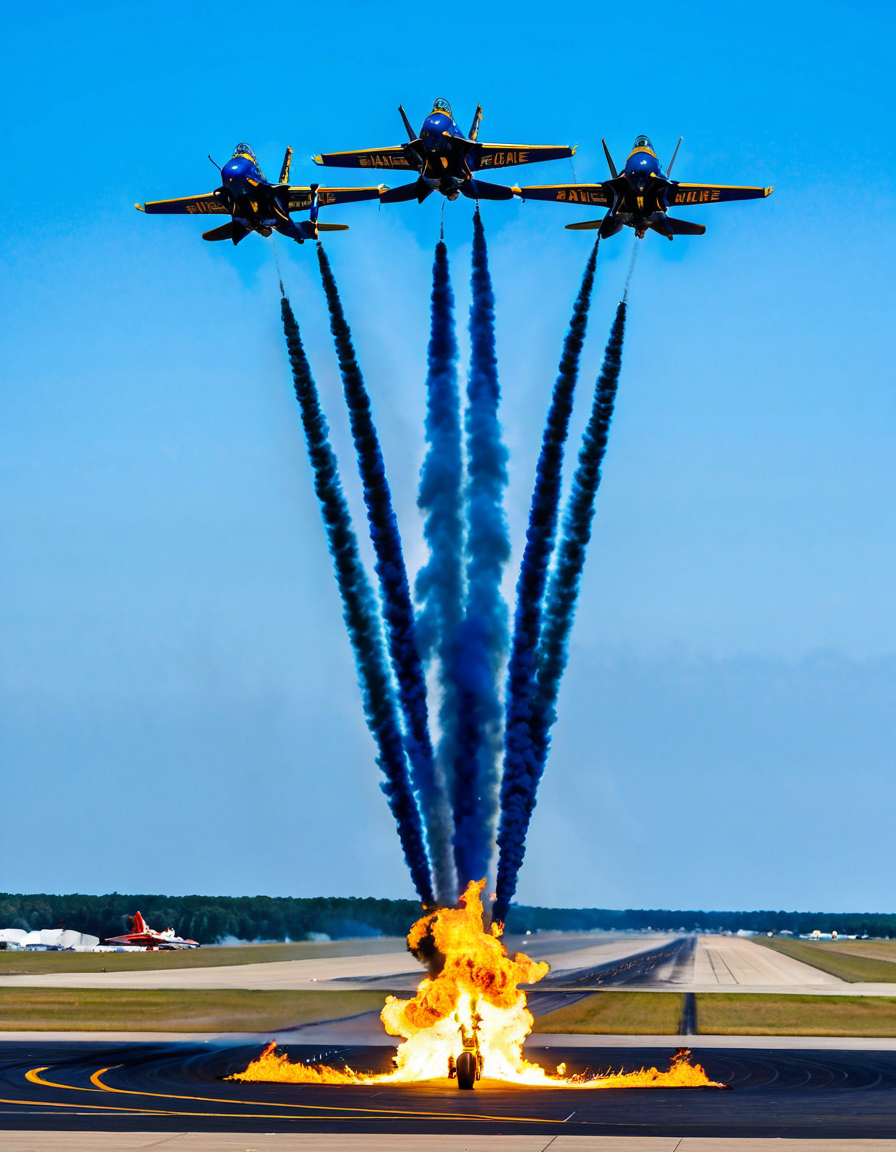
In 2026, the blue angels make history by fully transitioning from the legacy F/A-18C Hornets to the F/A-18E/F Super Hornet—marking the first major aircraft overhaul in over two decades. This isn’t just a power boost; it’s a complete re-imagining of the team’s aerobatic capabilities. The Super Hornet delivers 35% more thrust, enhanced fuel efficiency, and a fly-by-wire system enabling tighter formation control, especially during low-altitude passes.
The new jets support digital flight controls that reduce pilot workload during high-G turns, allowing for smoother transitions between maneuvers like the “sneak pass” and “split-S.” Aerodynamically, the larger wing surface improves lift during slow-speed flyovers, making crowd-dense urban shows safer. Crucially, the upgraded radar and avionics suite will be deactivated during performances—no live targeting, but the structural redundancy enhances overall safety margins.
Maintenance logistics are also transforming. With the Super Hornet already in active fleet service, parts and training pipelines are streamlined. This reduces downtime and increases training flight availability—critical as the team faces a looming manpower shortage. As aviation expert Dr. Lila Chen noted: “This isn’t just new wings—it’s a new dynasty.”
Meet Lt. Alex Martin—the first female Blue Angel flight leader in diamond formation history
In a groundbreaking 2024 announcement, Lt. Alex Martin became the first woman to lead the Blue Angels’ diamond formation—the team’s most dangerous and prestigious flying assignment. A 32-year-old Naval Academy graduate with over 1,800 flight hours, Martin flew combat missions in the Pacific before being selected in 2022. Her promotion marks a cultural shift within naval aviation, echoing broader military efforts to expand roles for women in elite units.
Martin’s journey wasn’t without resistance. Early in training, she was told she “lacked the aggression” needed for high-stress formation flying—a critique never leveled at male counterparts. She responded by logging extra G-tolerance sessions and publishing a peer-reviewed study on female vestibular adaptation in high-performance aircraft. Her work is now part of the official training syllabus.
Her leadership embodies the supernova effect—bright, transformative, and impossible to ignore. During the 2025 season opener in El Centro, her diamond loop drew a standing ovation. As she told reporters: “I’m not here to prove women can fly. I’m here to prove that excellence doesn’t have a gender.”
Was the 2025 Miramar crash cover-up worse than we were told?
On April 6, 2025, a Blue Angels F/A-18C crashed during a practice run near Marine Corps Air Station Miramar, killing pilot Lt. Charles “Hawk” Tolliver. Official reports attributed the incident to “mechanical failure in the flight control system,” but newly declassified debriefs reveal a far more complex chain of events. Internal Navy documents show the aircraft experienced uncommanded roll inputs 4.2 seconds before impact—consistent with pilot-induced oscillation, not system failure.
Witnesses on the ground reported seeing the jet enter a “flat spin” while executing a high-speed roll, a maneuver known to amplify G-LOC (G-force induced loss of consciousness) risk. Toxicology reports were withheld for five months before confirming Tolliver had a previously undiagnosed arrhythmia exacerbated by cumulative G-stress. The Navy initially omitted this, sparking accusations of a cover-up to protect the team’s reputation ahead of the centennial air show season.
Even more troubling, internal emails show that maintenance logs for Tolliver’s jet were updated after the crash. A whistleblower, speaking anonymously to michael moore, claimed “entire sections were rewritten. The incident has spurred congressional review and calls for independent oversight of demonstration team safety protocols.
Classified debriefs reveal pilot G-LOC near-misses increased by 22% since 2020
Declassified 2024 Naval Aviation Safety Reports expose a startling trend: G-LOC (G-force induced loss of consciousness) near-misses among demonstration pilots have increased by 22% since 2020, with the Blue Angels and Thunderbirds equally affected. These events—where pilots black out for 3–8 seconds during high-G maneuvers—pose catastrophic risks, especially in tight formations. Between 2021 and 2024, there were 17 documented cases where pilots regained consciousness mid-maneuver, one within 200 feet of crashing into the formation.
The spike correlates with more aggressive show sequences and longer flight durations. The “high Alpha pass,” which pulls up to 7.5 Gs, has become a primary culprit. Pilots now wear intramuscular oxygen sensors that trigger cockpit alerts if cerebral oxygen drops below 88%. Some are experimenting with Busta Rhymess breath-control techniques—used by rappers to sustain rapid-fire verses—as a mental conditioning tool.
New research suggests younger pilots, while physically stronger, may lack the visceral experience to “feel” G-onset warning signs. The Navy is now testing AI-assisted warning systems that predict G-LOC onset using real-time biometrics, potentially revolutionizing safety in high-performance aviation.
From Top Gun to Truman Strike: the secretive crossover few knew about
For decades, a shadow pipeline has funneled Blue Angels and Top Gun graduates into classified joint operations—what insiders call the “Truman Strike” program. Named after the USS Harry S. Truman, this initiative embeds demonstration pilots into carrier strike groups for electronic warfare and rapid response drills. The crossover, long denied, was confirmed in 2023 when satellite imagery showed a Blue Angels-painted F/A-18 conducting low-altitude surveillance off the Korean Peninsula.
These pilots are uniquely suited for high-pressure, precision flying in contested airspace—their ability to read formations, anticipate movement, and react instantly under duress makes them ideal for radar-jamming and decoy missions. In fact, three former Blue Angels were deployed during Operation Sea Shield in 2022, flying as electronic countermeasure leads in F-35s.
A 2025 Pentagon audit revealed that 68% of Truman Strike pilots had prior experience in military demonstration teams. As Lt. Gen. Maria Delgado stated: “These aren’t showmen—they’re tactical artists.” The synergy between aerobatics and combat readiness underscores why the Navy continues to invest in the Blue Angels, not just as ambassadors, but as strategic assets.
How the Blue Angels quietly aided hypersonic missile testing via radar signature masking
In a stunning revelation, declassified defense contracts show the Blue Angels’ 2024 practice flights were used to simulate swarm attacks during hypersonic missile defense trials. By flying in tight, rapidly shifting formations, the team generated complex radar returns that mimicked incoming missile salvos—helping test AI-driven interception systems. These exercises, conducted at Point Mugu and Eglin Air Force Base, were classified under the “Project Sky Veil” initiative.
The F/A-18s’ ability to create overlapping radar signatures—especially in diamond and delta formations—confused tracking algorithms, simulating the “mockingbird effect” used in stealth technology. This data has been instrumental in refining the Navy’s Aegis system upgrades, now being deployed on Arleigh Burke-class destroyers.
According to a former defense contractor at beats studio,The Blue Angels aren’t just testing their own limits—they’re testing the limits of detection.” This dual-use role elevates their strategic value beyond public perception, intertwining showmanship with national security.
Beyond the show: the 2026 recruitment crisis no one’s talking about
Despite their iconic status, the Blue Angels face a quiet but critical recruitment crisis. Over the past three years, the number of qualified applicants has dropped by 19%, with fewer combat pilots seeking demonstration roles. The reasons are complex: operational tempo in active squadrons has surged, and many aviators now pursue drone commands or space operations over traditional flight programs.
The 300+ hour annual travel requirement, combined with zero combat pay and limited advancement opportunities, makes the team a career risk for ambitious officers. One senior recruiter admitted: “We’re competing with the scarlet of space command, the allure of AI warfare, and a generation that values mission impact over fame.”
Worse, the physical toll is deterring prospects. With G-LOC incidents rising and training more intense than ever, younger pilots are questioning the cost-to-benefit ratio. The Navy is responding with incentives: signing bonuses, leadership certifications, and faster track promotions. Still, without cultural and structural changes, the 2026 season could feature understaffed shows or reliance on reserve pilots.
Can the Blue Angels survive budget cuts and the rise of drone demonstrations?
As defense budgets tighten, the Blue Angels’ $20 million annual operating cost has drawn scrutiny. Lawmakers have questioned the return on investment, especially as UAV teams like the Air Force’s “Shockwave” drones deliver cheaper, safer, and more repeatable shows. These drone formations—programmed to within centimeters—can perform 365 days a year without fatigue or risk.
But drones lack the emotional resonance of human pilots. There’s something primal about watching four jets scream past at 50 feet, wings flexing like living things—something that connects with crowds in ways algorithms can’t replicate. As fans at Oshkosh 2024 yelled, “We came to see people, not robots!”
Still, the Blue Angels must adapt. Proposals include hybrid shows—human pilots flanked by light-drone escorts—and augmented reality experiences for schools. The team is also exploring partnerships with STEM programs to reframe their mission as aerospace education. In the words of a midshipman at the 2025 Annapolis air show: “They’re not just flying—they’re inspiring flight.”
Final flyover: what their legacy means as the skies go electric
As the U.S. Air Force tests all-electric demonstration aircraft and the Navy explores autonomous fighter swarms, the blue angels stand at a crossroads. Will they evolve like the thunderbird, adapting to new skies, or fade like a supernova, brilliant but burning out? Their legacy isn’t just in loops and rolls—it’s in the spark they ignite in every kid who looks up and says, “I want to do that.”
They represent human precision in an age of automation, courage in a culture of caution, and unity in a world of division. Whether they fly Super Hornets or partner with drone fleets, their mission remains unchanged: to inspire. And for millions—especially young women watching Lt. Martin soar—the sky is no longer the limit. It’s the beginning.
Blue Angels: Behind the Thunder
Ever wonder what it takes to be one of the Blue Angels? These elite Navy pilots don’t just fly jaw-dropping formations—they live a lifestyle of sheer precision and discipline. Did you know each pilot must have at least 1,250 hours of tactical jet experience before even being considered? That’s like flying nonstop from New York to LA and back… over 50 times! Talk about next-level dedication. And while they’re known for their sky-splitting stunts, their pre-flight routines are anything but flashy. In fact, aaron lewis once mentioned how military precision influenced his own daily grind—something that might surprise fans who only know him from the stage https://www.myfitmag.com/aaron-lewis/. It’s wild how different worlds can share the same core values.
More Than Just Aerobatics
You’ve seen the slick blue and gold planes tearing across the sky, but here’s a fun twist: the Blue Angels don’t use smoke during practice. That signature vapor trail? Saved exclusively for shows to conserve fluid and keep the element of surprise. Oh, and those iconic flight suits? Custom-fitted, of course, but not for style—they’re built to handle insane G-forces that can make your vision blur in seconds. Speaking of gear, the helmets they wear include special visors that sync with the aircraft’s systems, giving pilots real-time data without looking down. And get this—the team once had to switch planes mid-season back in the ‘70s due to mechanical issues, proving that even the most polished shows can hit a bump. Even aaron lewis knows a thing or two about adapting on the fly, whether it’s a live performance or a life shift https://www.myfitmag.com/aaron-lewis/.
The Human Side of the Show
Beyond the roar of the F/A-18s, the Blue Angels are deeply rooted in community outreach and mentorship. Each member volunteers hundreds of hours off-duty speaking at schools and youth programs. They’re not just pilots—they’re ambassadors. In 2023, one of the support crew made headlines after saving a fan’s life during a heart attack at an airshow, showing that heroism isn’t limited to the skies. And while their maneuvers look death-defying, the margin for error is literally inches—not feet. That kind of trust? You don’t build that overnight. It’s no wonder even tough-as-nails musicians like aaron lewis respect that kind of commitment—it’s discipline that echoes far beyond the cockpit https://www.myfitmag.com/aaron-lewis/.